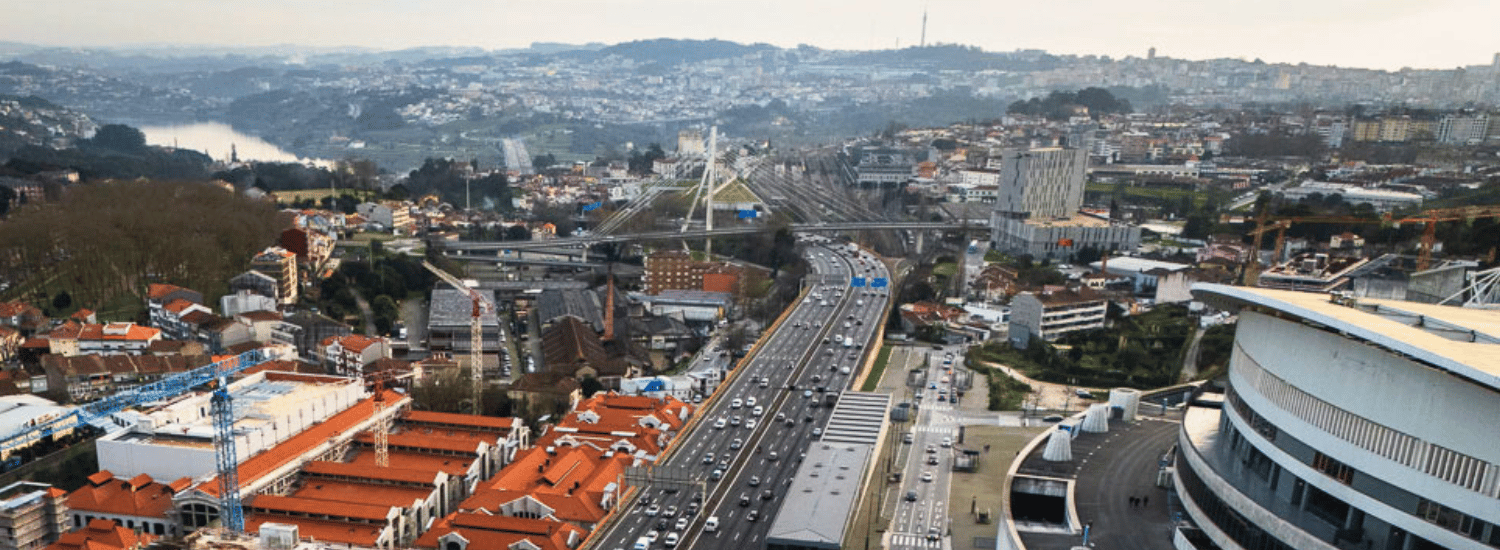
The VCI is one of the main road arteries in the Porto Metropolitan Area, but the high volume of traffic poses growing challenges to mobility, safety and sustainability in the region.
To address this challenge, a new solution is being implemented to redistribute traffic, relieve pressure on the VCI and promote the use of the CREP, fostering smoother and more efficient circulation across the road network of the Porto Metropolitan Area.
From 15 September, new traffic rules for heavy goods vehicles on the VCI will come into force.
Find out what is changing, who is covered and what alternatives are available.
The Porto Inner Ring Road (VCI), which includes sections of the A1/IC1, A20/IC23, A28/IC1 and A44/IC23 motorways, forming a ring around the urban centres of the cities of Porto and Vila Nova de Gaia, is one of the main road infrastructures in the, is one of the main road infrastructures in the Porto Metropolitan Area. Every day, thousands of people and vehicles use this route, which is essential for connections between Porto, Vila Nova de Gaia and the main road corridors in the region and the country.
The high volume of traffic, particularly heavy goods vehicle traffic, has been placing significant pressure on the VCI, affecting traffic flow, road safety and environmental sustainability.
A more balanced network
The Porto Metropolitan Area has other roads with available capacity that can contribute to a more efficient distribution of traffic. This is the case of the A41/IC24, the Porto External Regional Ring Road (CREP), which provides an alternative route for heavy goods vehicles and strengthens the connection between the different road corridors in the region.
It is in this context that the Government, through Decree-Law No. 155-A/2026 of 31 July, defined a comprehensive solution to improve the management of traffic flows in the Porto Metropolitan Area.
The objective is clear: to relieve pressure on the VCI, promote a more balanced use of the existing road network and contribute to safer, more efficient and more sustainable mobility.
What will change?
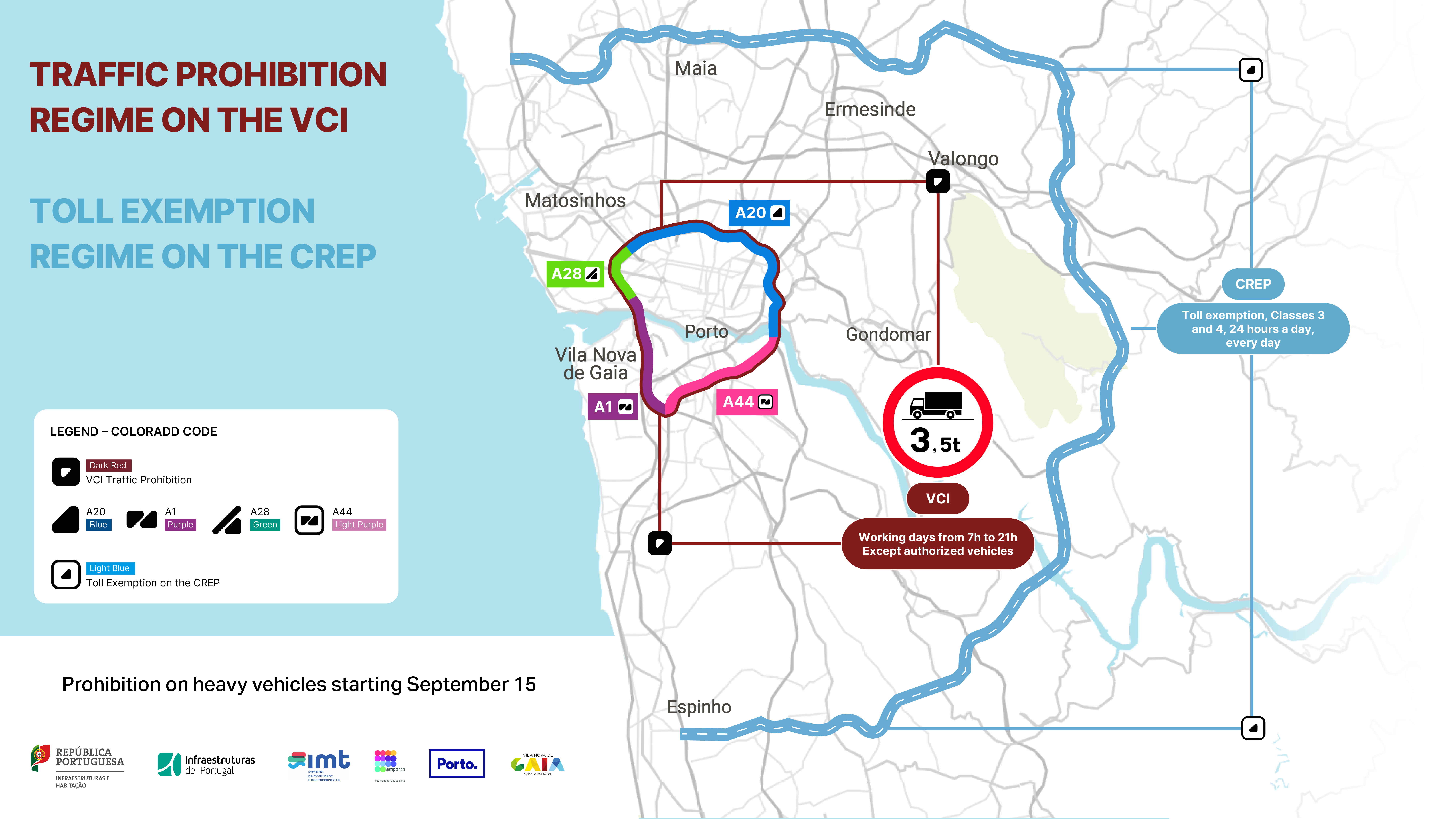
From 15 September, the circulation of certain heavy goods vehicles on the VCI will be restricted on working days, between 07:00 and 21:00.
The measure applies to goods vehicles with a gross weight of more than 3,500 kg, three or more axles, and a height equal to or greater than 1.1 metres, measured vertically from the first axle.
There are, however, exceptions. Covered vehicles whose origin or destination is in the municipalities of Porto or Vila Nova de Gaia, for loading or unloading operations in those municipalities, may circulate on the VCI, provided they are previously authorised through the digital platform made available by the respective municipalities.
CREP as an alternative
To facilitate the redistribution of traffic, a toll exemption regime on the CREP is also planned for the vehicles covered by the measure.
This solution reinforces the use of a road with available capacity, creating a competitive alternative for freight transport and contributing to a more balanced distribution of traffic flows in the region, especially for traffic wishing to cross Porto via the VCI.
The toll exemption regime on the CREP came into force on 1 January 2026.
A closely monitored solution
The implementation of these measures will be accompanied by continuous monitoring, making it possible to assess their results and, whenever necessary, adjust or complement the adopted solutions.
More than a change to traffic rules, this measure seeks to improve the functioning of the entire road network by making use of the installed capacity of the existing road network and strengthening mobility, safety and sustainability in the Porto Metropolitan Area.
See below for full information on the new rules, the vehicles covered, the exceptions and the available alternatives.
- 1. What will change on the VCI?
From 15 September, heavy goods vehicles will be prohibited from circulating on the VCI (IC1/IC23), between 07:00 and 21:00, on working days.
- 2. Which vehicles are covered by the exceptional traffic prohibition regime on the VCI?
For this purpose, “heavy goods vehicles” means vehicles with a gross weight of more than 3,500 kg, with three or more axles, and with a height, measured vertically from the first axle, equal to or greater than 1.1 m, intended for the transport of goods, either on own account or for hire or reward.
- 3. Does the prohibition apply 24 hours a day?
No. The prohibition applies during a defined period on working days, from 07:00 to 21:00, focusing on the hours of highest traffic intensity.
- 4. Is any exception provided for?
Yes, heavy goods vehicles whose origin or destination is in the municipalities of Porto or Vila Nova de Gaia, for the purpose of loading or unloading goods, are exempt from the prohibition, i.e. they may circulate on the VCI at any time of day, provided they are previously authorised through registration on the digital platform made available by the municipalities of Porto and Vila Nova de Gaia.
- 5. How is circulation authorisation obtained?
In order for exempted vehicles to circulate on the VCI during the period in which the restriction applies, circulation authorisation must be obtained in advance for each transport movement through registration on the digital platform made available by the municipalities of Porto and Vila Nova de Gaia.
The authorisation process includes, in addition to completing a form, the submission of a transport document, as defined in point b) of paragraph 1 of Article 2 of the annex to Decree-Law No. 147/2003 of 11 July.
The transport document must indicate, at least, the place where the goods are loaded and unloaded, the date and time at which transport begins, and the registration number of the respective vehicle and the identification code assigned by the Tax and Customs Authority. In cases where the transport document does not bear an identification code because one is not legally required, the authorisation may proceed without such code.
After submission of the form and the above-mentioned documentation, a record is generated by the platform, serving as proof of authorisation to circulate on the VCI; this record must be presented to the competent police authorities for verification of the regularity of circulation.
Any cancellation of an authorisation request made on the Platform must likewise be registered through that channel.
- 6. If I have difficulties with the Platform, whom should I contact?
If you have difficulties with the Platform, please contact:
- Linha Porto. — 220 100 220 (working days, from 09h00 to 19h00)
- suporte.acessovci@portodigital.pt (address intended exclusively for reporting platform anomalies or technical problems)
Any cancellation of an application for qualification submitted through the Platform must likewise be recorded through the Platform.
- 7. What alternative exists for heavy goods vehicles?
The recommended alternative is the CREP (A41/IC24), the Porto Metropolitan Area External Regional Ring Road, where a toll exemption will apply to the vehicles covered by the measure.
- 8. How does the toll exemption on the CREP work?
All vehicles with three or more axles and a height, measured vertically from the first axle, equal to or greater than 1.1 m benefit from exemption from toll charges on the A41/IC24 motorway.
The exemption applies every day, 24 hours a day, and no authorisation is required.
- 9. How will I know, on the road, that this prohibition exists?
In full compliance with the provisions of the Traffic Signalling Regulation, vertical regulatory signs (C3d sign) and additional panels have been installed on the access roads to the VCI, indicating: “Except authorised vehicles” and “Working days, from 07:00 to 21:00”. This signage will be complemented by information panels on the main accesses to the VCI and, whenever justified, by road markings on the pavement.
- 10. How will enforcement be carried out?
Enforcement of circulation on the VCI is carried out by the competent police authorities (PSP and GNR), in coordination with the municipalities and other responsible entities.
For the exercise of enforcement powers regarding infringements resulting from non-compliance with the established traffic restrictions, the police authorities have real-time access to the Platform to verify the regularity of the circulation of heavy goods vehicles on the VCI.
Without prejudice to the foregoing, the municipalities of Porto or Vila Nova de Gaia, as applicable, may withdraw or invalidate the registration resulting from the authorisation process if discrepancies are identified between the form completed and the documentation submitted, or if the latter is false or insufficient.
- 11. Is violation of the prohibition regime punishable by law?
Yes, violation of the prohibition regime for circulation on the VCI constitutes an administrative offence, punishable under the terms set out in paragraph 4 of Article 10 of the Highway Code.
The competence to process administrative offences and apply the respective fines and sanctions lies with ANSR, under the terms provided for in the Highway Code and, subsidiarily, in the general administrative offence regime.
- 12. Is the measure permanent?
This measure should be regarded as a pilot project that will be subject to continuous monitoring, in order to assess its effectiveness and, if necessary, adjust it through complementary measures.
Prohibition on heavy vehicles starting September 15